



บทนำ
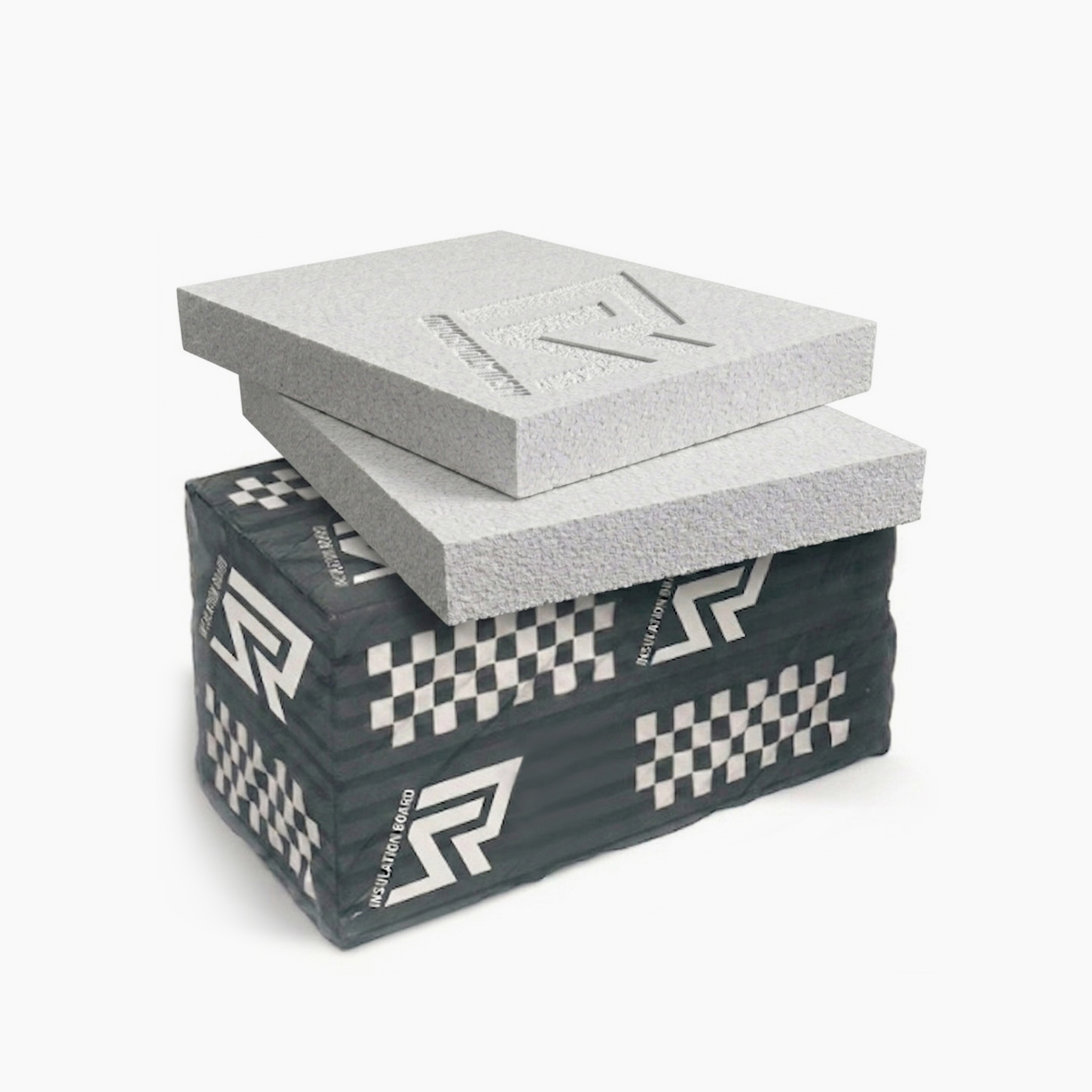
As global high-rise buildings evolve into “vertical cities,” the safety of exterior decoration and insulation systems faces severe trials. Traditional “thin-plaster” systems often risk cracking, hollowing, or even detachment due to complex on-site construction environments. The “Bonding & Anchoring” integrated system developed by RSinsulationboard provides a reliable “anti-detachment shield” for super-tall structures through factory prefabrication and a dual-redundant loading structure.
The Mechanical Logic of “Bonding & Anchoring”: A Dual-Insurance System
In high-rise structures, the system must withstand immense negative wind pressure and seismic shear forces.
First Insurance: High-Performance Bonding Mortar (Chemical Bonding)
Function: Achieves full bonding between the insulation layer and the substrate wall (Effective bonding area≥40% ).
Advantage: Evenly distributes positive and negative wind pressures, reducing local stress concentration on the panels.
Second Insurance: Mechanical Anchoring System
Function: Utilizes stainless steel or high-strength alloy anchors with an effective depth ≥50mm into the substrate wall.
Advantage: Specifically for high-wind-load zones, anchors provide a “strong constraint” perpendicular to the wall. Even under extreme conditions of bonding failure, they ensure the panels do not fall.
Seismic Performance Research: Flexible Connections and Displacement Compensation
High-rise buildings generate significant interstory drift during earthquakes.
Stress Release Mechanism: The RSinsulationboard system utilizes weather-resistant silicone sealant and flexible joint strips at panel seams to absorb minor deformations of the primary structure, preventing compression cracking.
Simulated Test Data: Verified by our laboratory technical systems, the system shows no panel fractures under simulated Magnitude 8 earthquake conditions, with anchor point displacement remaining well within safe limit values.
Managing Extreme Wind Pressure: The “Pull-out” Challenge in Skyscraper Construction
At heights exceeding 100m , negative wind pressure at the corners of a building increases exponentially.
RS Experimental Standards: Our products have successfully passed the SGS wind load simulation tests. Leveraging advanced manufacturing equipment, we ensure superior composite strength between the rear reinforcement ribs and the insulation core, achieving a tensile bonding strength of ≥0.15MPa.
Differential Anchoring Layout: We provide customized anchor arrangements (edge densification and center reinforcement) for different height zones of the building to ensure overall load balance.
Factory Prefabrication: Eliminating “On-site Human Error”
The success of “Bonding & Anchoring” lies not only in design but in manufacturing.
CNC Composite Process: RSinsulationboard utilizes fully automated composite equipment, ensuring molecular-level bonding between the panel and the insulation layer in vacuum/high-pressure environments. This avoids the detachment risks caused by air pockets often found in traditional on-site manual lamination.
Standardized Hole Positioning: Prefabricated anchoring holes reduce structural damage caused by on-site drilling and enhance installation precision.
Conclusion: From “Decorative Facade” to “Defense System”
The Bonding & Anchoring system by RSinsulationboard has verified its superior anti-detachment performance in multiple international super-high-rise projects. It is more than just a decorative facade; it is an insurmountable safety red line for the building’s entire life cycle.